

One of the many side effects of abuse is a negative or fractured sense of self, and I’ve certainly experienced it as I look back over my life story, or wrestle through my current life struggles and sins, or sometimes just for who I am as a person existing. Recently, I have become quite fed up with my internalized sense of shame, particularly the way that it affects what I believe about God’s love for me.
This felt shame is not the same thing as conviction for sin, and the sweet confidence I have that I can go to God and confess my sins, and receive assurance of pardon. It’s a feeling that makes me want to hide from everyone, including God, and believe that in some deep way I am too broken to be fixed, and that I am unlovable to my core, that God might not really love me the same way He does other people. I learned to name it more clearly recently, and as a result, I have been searching Scripture, praying, and seeking various forms of counsel on it. In response, God has been faithfully and undeniably showing up in my life, bringing deep, healing, heart-changing encouragement, and even conviction and repentance, bringing me further into the light of the truth of who I am in Christ.
My family loves taking fall drives and hikes in the mountains, and our five year old daughter is old enough now to remember this yearly tradition, and begged us to go to the mountains a couple weeks ago. First, we stopped for a couple hours at an orchard/winery with mountain views and farm animals, but that was not enough for her. She kept asking to go up into the mountains so she could “look down” and so we could “take a picture on a rock together.” So, with not a lot of time left before her bedtime, we drove onto the parkway, and found one of our usual stops, with a short walk to the rocks where she wanted to take a picture.
This year, she started off holding my hand, but then, she wanted to walk by herself, and she was much more confident in her steps, even jumping on and off the smaller rocks. I walked next to her, looking down at her little pink cowgirl boots navigating the path, remembering vividly our same walk last year. A year ago, she was scared, and needed me to hold her hand the whole time, and her footsteps were not sure. I even had to convince her to keep going.
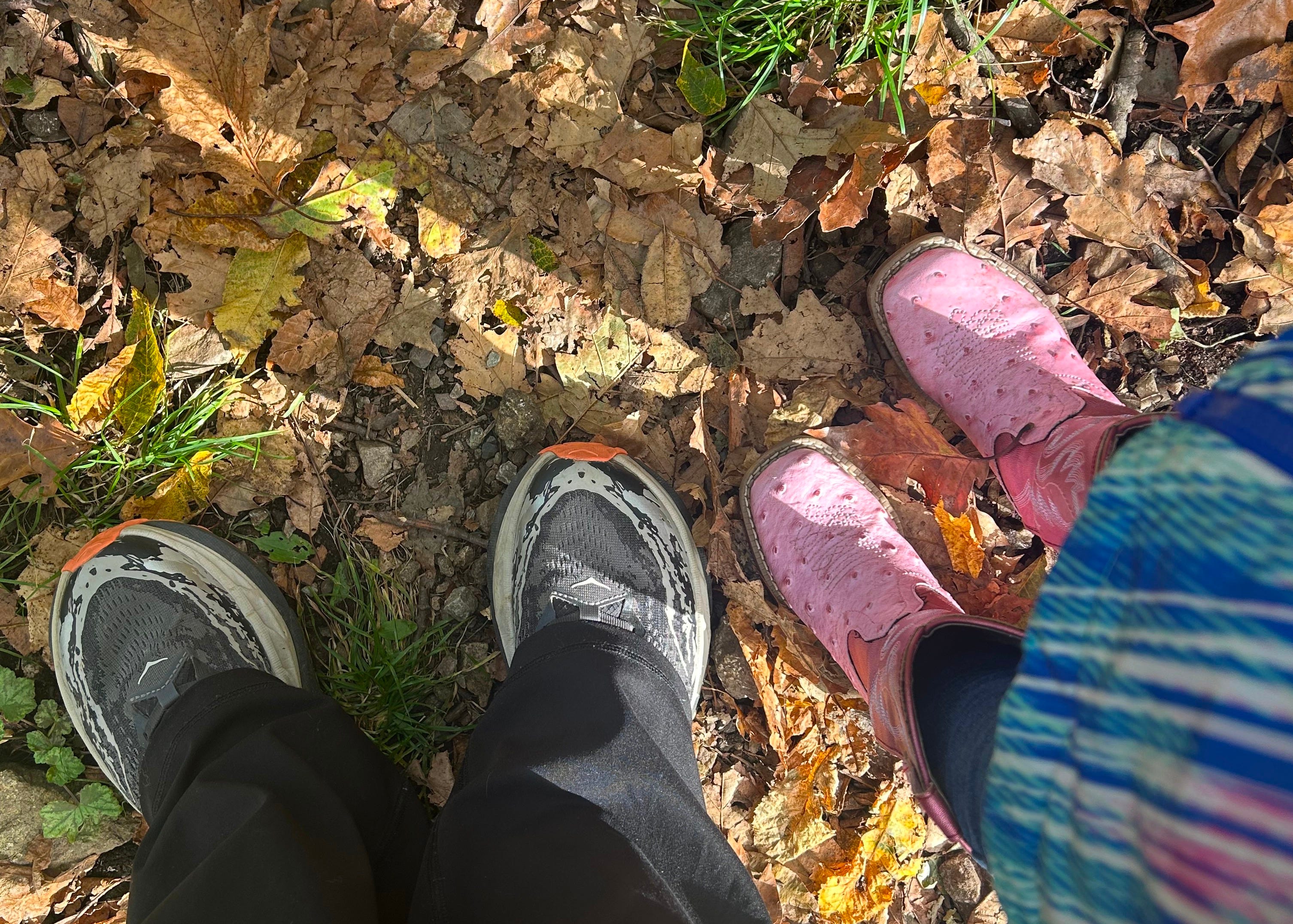
It washed over me in that moment that as proud as I am of her this year, excited about her bravery, and growth, I was not suddenly ashamed of her last year, when she walked with faltering and scared steps. And then, it occurred to me that next year, she’d be able to do more, and is only going to keep growing up more quickly than I would like. I am not ashamed of her for being a very little girl right now, with so much growing and learning left to go.
I felt my chest tighten in that moment because I recognized that this is the same way with me, with us, God’s children. I am often tempted to feel ashamed of myself, of my past, and the early days of recovery, or even before that, of the many years where I lived in constant fear and abuse. Then, I look at where I still struggle now, and sometimes feel shame and for that, too. I wish I could be stronger, braver, more healed, more faithful, less sinful. But, like watching small pink cowgirl boots walking along a rocky trail, I see my own feet now as stronger and more stable than they were a few years ago, even a few months ago, and I must not despise or be ashamed of that past form of myself, or of my current form, for that matter. I know that God is continually and lovingly working in and sanctifying, shaping me more and more into his image.
Earlier this week, my daughter asked me to play what she calls “Not to Us” on the way to school. It’s actually called “The Glory of God” by Shai Linne from his 2011 album, The Attributes of God. I don’t mind obliging her taste in Christian rap, and as I listened, a line stood out to me, “Steadfast love is intimate.”
In my last post, I wrote about Psalm 103, and I keep coming back to it. Here are verses 10-14:
For as high as the heavens are above the earth, so great is his steadfast love toward those who fear him; as far as the east is from the west, so far does he remove our transgression from us. As a father shows compassion to his children, so the LORD shows compassion on those who fear him. For he knows our frame; he remembers that we are dust.
I think this portion of Psalm 103 is describing the intimacy of the steadfast love of God toward his children.
Verse 11 describes an unchanging love with deep knowledge of who we are, especially our sins, which He has removed from us. He made us, and He knows us better than we know ourselves, completely, our sins, fears, insecurities, wounds, and yet, he still describes his love toward his children as steadfast, faithful, unchanging. He delights in us, and understands knows us and our personalities. And we can take great comfort in the fact that, “…he knows our frame; he remembers that we are dust.” He knows how we are made and how our life’s experiences have shaped and affected us. He knows our weakness, and he shows us compassion like a father to a child.
Out of steadfast love, with tender, patient, intimate knowledge of our who we are, our Heavenly Father sanctifies us throughout our journey on the earth. Westminster Shorter Catechism1 says,
Sanctification is a work of God’s free grace, whereby we are renewed in the whole man after the image of God, and are enabled more and more to die unto sin, and live unto righteousness.
I think I cite Romans 8 nearly every single post lately, but that’s okay with me! Here we go again. Romans 8:28-29a says, “And we know that for those who love God all things work together for good, for those who are called according to his purpose. For those whom he foreknew he also predestined to be conformed to the image of his Son…” It’s right there, all these trials and experiences in our lives are all being used to sanctify us and conform us into the image of Christ, and he does this with a love so deep we cannot fathom it. He’s not angrily dragging us around irritated with us for not looking very much like Jesus. He is lovingly, patiently, and providently working through all things, conforming us into the image of his Son.
Romans 8:31-39, goes on to give us the confidence that God is for us and there is nothing that can separate us from the love of God in Christ Jesus. My friends at the Reclamation Podcast2 often say, “Sanctification is a promise, not a threat,” and I love that. So often, I think we feel condemnation, shame, and even dread when we think of sanctification. And while the process of sanctification is often painful, and it does last our entire lives on earth, we must remember it as a gracious promise, and not a looming threat, from the intimate, steadfast love of God to us His children.
How wonderful that God gives us a picture of a father to his children, something we can understand! It reminds me of Matthew 7:11, “If you then, who are evil, know how to give good gifts to your children, how much more will your Father who is heaven give good things to those who ask him.” Even in my diminished and sinful capacity, I understand my love for my daughter, even my imperfect compassion and patience for her walking in the mountains in her pink cowgirl boots. How much more is God’s love and patience towards us as we go through the growing and sanctifying experiences of walking through life on earth?
So we must not be ashamed of ourselves in the midst of this growth, because we know that “There is therefore now no condemnation for those who are in Christ Jesus.” (Romans 8:1) This verse follows Romans 7:14-25, where Paul famously describes the war within, “I do not do what I want, but I do the very thing I hate….” Even though we experience this same war, as we participate in our sanctification, and fight against our own sin, we have been declared righteous because of the work of Jesus on our behalf. We must not believe that should isolate ourselves from God or hide ourselves away in shame. He is not ashamed of us.
Our security and love rests not in anything we have done ourselves. I am reminded of this beautiful passage in Hebrews 4:14-16:
Since we then have a great high priest who has passed through the heavens, Jesus, the Son of God, let us hold fast our confession. For we do not have a high priest who is unable to sympathize with our weaknesses, but one who in every respect has been tempted as we are, yet without sin. Let us then with confidence draw near to the throne of grace, that we may receive mercy and find grace to help in time of need.
Jesus did the work that we could not do, and bore the reproach and shameful death we could not bear. He is able to sympathize with us and yet without sin, securing our eternity, and we have been given the gift of confident access to the throne of grace. Shame, discouragement, and ungodly fear are not from our Heavenly Father, nor are they the benefits of our salvation secured for us by Christ, and applied to our hearts by the Holy Spirit Shame does not belong to us anymore.
Westminster Shorter Catechism Question 35 (With Scripture proofs)