

Last Friday, I started this little series for my Friday posts on engaging our stories. Today, we’re going a little deeper into the sufficiency of scripture in our trauma stories.

It was middle of October of 2013 and I can remember how I was feeling. My mind was spinning with rapid thoughts, eyes moving quickly, short breaths, and I felt like bursting out of my own skin from head to toe. I was terrified, convinced even, that I was alone and that no one could understand me well enough to help, and nothing was safe. I was triggered. I was in anguish and pain. I felt like I was losing my mind, and I was trying to process my entire life, but I didn’t know how. I was desperate to know the truth of what happened in the cult I just left, and in my own family, but no one could explain it. And, I felt like not only was I voiceless, and no one was listening to me, but that I was also being drowned.
When I first left the cult, I sought refuge in another church that turned out to be spiritually abusive in different ways than how I grew up. I had been trying to get the pastor and his wife to listen to me, and to try to understand the despair I was experiencing. They had me come to their home every other Tuesday, and have sort of counseling sessions in their basement after dinner. I have mixed feelings about those days. They welcomed me into their home when I had no family, and they even helped me leave the cult I grew up in. However, the pastor was ill-equipped to help me, but that didn’t stop him from giving me a book by Jay Adams, and telling me that my depression (the only word I had for it at the time) was sinful and the result of self-focus.
I remember trying to advocate for myself, trying to research and understand that something different was happening than simply sinful self-focus. I brought a list of books about spiritual abuse to the pastor and begged him to read them so he could know what was happening with me, but he didn’t read them. He actually made me promise to stop researching spiritual abuse, and told me instead to read the Jay Adams book about how Scripture was all I needed to heal.1
That is an example of how sometimes, oftentimes, particular types of biblical counseling can go extremely wrong, and be very dangerous.
I’m sharing this because I want you, dear fellow survivors, to know that I understand the kinds of pain that people with good or bad intentions have done by stressing the sufficiency of Scripture and faith in healing from trauma, without having an actual biblical view of suffering, an understanding of the serious effects of trauma, or even what the Bible actually does say to someone after trauma. I want you to know that there is a difference between what they may have said, and what I want to say about the sufficiency of Scripture to speak to and inform your trauma of truth (in addition to whatever professional mental health work you need).
So, back to the bad counseling story, I listened to the pastor, and I did seek comfort in the Word of God, and God did meet me there. However, I did not see nearly complete healing in my symptoms for more than 10 years after finally seeking qualified mental health therapy. I want to stress that although the counsel I received was terrible and dangerous, I did cry out to God in that season, and He met me where I was in His Word, in the book of Job. There, I saw Job’s friends, saying things very similar to what I’d heard recently about my own suffering. I began to wonder if my pastor and his wife were also “miserable comforters” like Job called his friends. I saw hope in those pages, and I believed that “my Redeemer lives,” and God gave me the strength to go on. I saw that what those unwise counselors were telling me was different than what God was saying in Scripture, and eventually it was Scripture that led me to leave that group as well.
That week in October 2013 when I was spiraling in fear and despair, and researching spiritual abuse, I found a helpful quote from a book called, Recovering from Churches that Abuse, by Dr. Ron Enroth. It says,“Spiritual abuse is a kind of abuse that damages the central core of who we are. It leaves us spiritually discouraged and emotionally cut off from the healing love of God.”
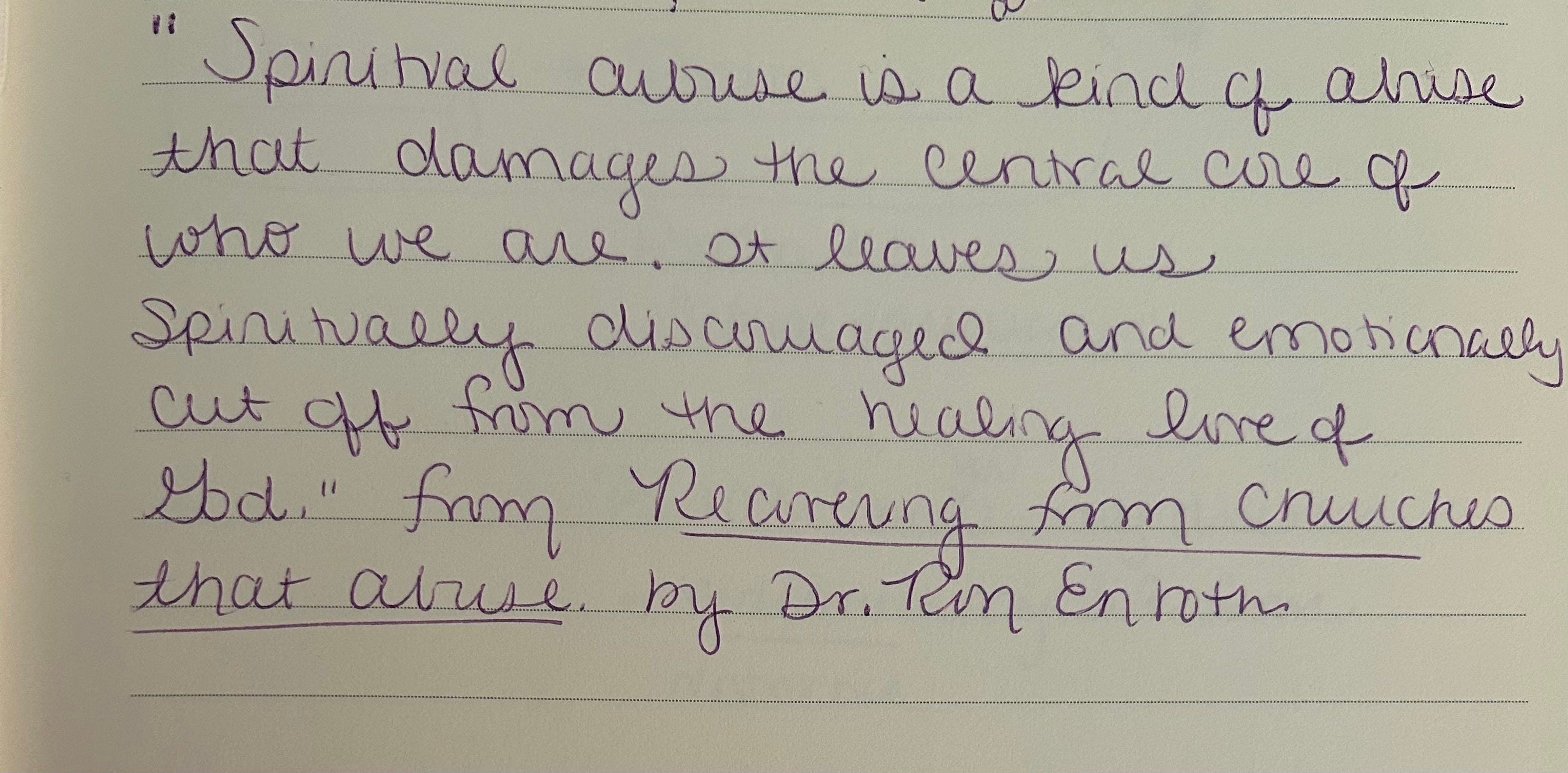
That quote helped me put words to what I was experiencing. Spiritual abuse (trauma) distorts our sense of self and our sense of God and who he is. And this is precisely why we need inform our trauma of truth because there, we will learn to take courage and to understand that we are not cut off from God in our times of grief and lament. There’s a danger in our stories of reacting to this kind of so called “biblical” counsel I described earlier by thinking that perhaps Scripture is not sufficient, or that it is too triggering to read, that can cut off the answer to finding a source of true and lasting healing in the depths of God’s Word, which actually is a very safe place for survivors to go.
II Timothy 3:16-17 says, “All Scripture is breathed out by God and profitable for teaching, for reproof, for correction, and for training in righteousness, that the man of God may be complete, equipped for every good work.” All Scriptures are from God. He did not just breathe on or give a little help as men were writing. Scripture is filled with the very words of God he breathed out to them as they wrote. These words are sufficient for everything you need, particularly, learning who God is, and who you are in light of that.
This II Timothy passage was used more like a weapon in the fundamentalist circles I was in, less confidence and comfort in the power of the Word, and more of a threat to be quiet and not ask questions. We had to accept whatever our leader said that it said, and any mental health struggle was demonic or spiritual and a lack of faith. But when we look at the whole Bible, we can find expressions of lament, grief, depression, despair, deep betrayal. We find Jesus, the one alone “who has the words of eternal life” 2. We can see that He experienced deep sufferings and temptations on Earth as a human, so that “we do not have a high priest who is unable to sympathize with our weaknesses,” and who endured without sin, so that we can now, “with confidence draw near to the throne of grace, that we may receive mercy and find grace to help in time of need.” 3God’s word is full of beautifully good news for you as a sinner, saint, and sufferer.
This is all I have time for this week, but next Friday, I want to spend some more time looking at how Scripture speaks specifically to us in our trials and suffering, and how we should not let trauma be our hermeneutic for reading Scripture.
As a reminder, at the time, I had, just a few months before, escaped a lifelong abusive cult, survived many years of complex trauma, lost my entire family, dozens of friends, and was writhing in internal anguish every single day, not sleeping at night, and struggling with thoughts of self harm so much so that I was afraid to be alone. My symptoms were normal and even to be expected, but I also needed professional help.
John 6:68
Hebrews 4:15-16
Thank you for your courage Sarabeth. While my own circumstances are different than yours, there are so so many parallels in my own life to what you went through. My family suffered at an spiritually abusive Bible-based church that can also be labeled as a cult, a high-control authoritarian group which had bad theology and taught false interpretations of scripture used to serve the leaders own agenda. I’ve learned so much through suffering and seeing others from that place go through similar things. It’s hard to not want to throw out all the good that God did do in my life despite the harm and hurt (for me over 16 years). Then bouncing to other churches that just don’t know how to speak to what we went through or what to do to help someone like me. I sought biblical counseling, pastoral counseling, study and prayer, and finally a licensed mental health professional and am starting to finally process all the years and unravel the knots. What is most difficult is trust. Trusting the Lord He sees my pain, wants me to be whole again and that I can trust Him to lead me to solid ground, to good pasture and trust church authority again, fellowship again. I’ve learned Jesus never leaves us while we venture through all the muck, He didn’t then and won’t now. I still hope there is a place where I can find community where people truly exemplify the love of Christ, His sacrificial and unconditional love where truth is not compromised and scripture is taught in context and is life-giving and isn’t used as a weapon to injure. A place where the hurting are accepted and not told to just get it together. My Faith in Christ has been tried through the fire so to speak but I still hope despite it all.
I really appreciate this, Sarabeth, and I look forward to seeing where you are headed in more detail. I wholeheartedly agree that our hermeneutic is a key component of both the harm and the healing in spiritual abuse. I’m actually working on a message on that subject for a conference next week, and thought I’d mention it since you quoted Peter’s words in John 6. While we cannot let trauma be our hermeneutic for the Bible, we must be able to see trauma *in* the Bible in order to learn a hermeneutic that is truly healing. I believe the Gospel of John teaches that hermeneutic, because the original audience of John re-read the story of Jesus as a hermeneutic for their own trauma. Everything changes once we see that. At least it did for me.